
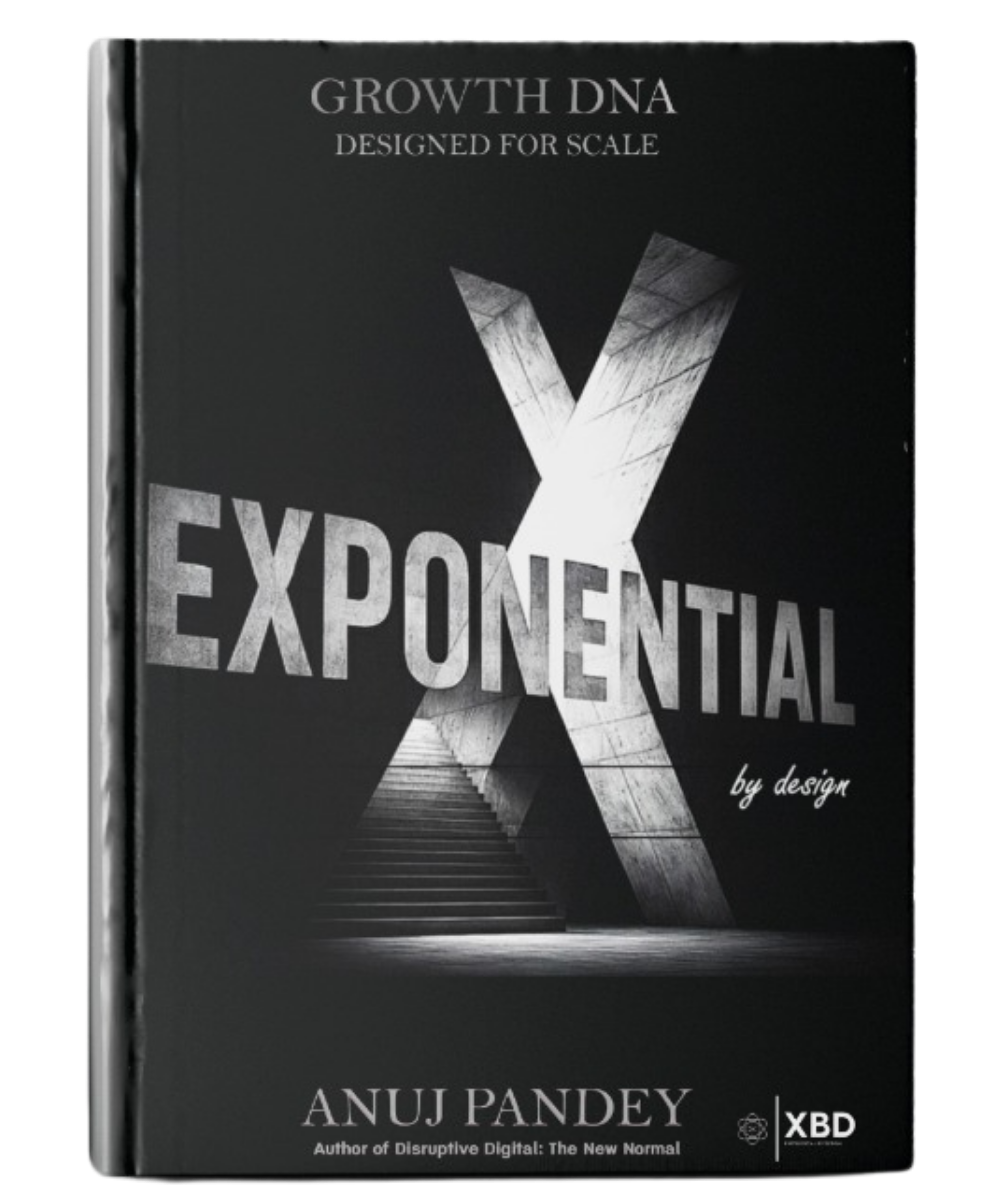
The book · by Anuj Pandey
Exponential by Design
Why growth in an AI-first world has become a design problem, and how the organisations that compound are built differently.
Hardcover & eBook · 331 pages · For leaders, transformation teams and management students
Endorsed by
Read by the leaders who run transformation.
- CP GurnaniCo-Founder & MD, AIONOS; former CEO, Tech Mahindra
- Najib KhanChief Business Officer, Ooredoo Group
- Kapil KaulCEO, CAPA India
- Amin MohammedCEO, KOUT Food Group
- Anant AroraBoard Member, SIF; CEO, Vasudha Foods
- Manoj JainChairman, Ideation 3X; Managing Partner, Flat Globe Capital
- Khushru SiganporiaStrategic and Board Advisor; former VP-IT, IHCL (Taj Hotels)
- Richard SymesFormer Head of ERP, British Council
The argument
Exponential growth is no longer a breakthrough. It is a choice made in the design.
The organisations that compound did not adopt technology faster. They designed for growth.
Most organisations still treat AI as a technology programme: buy the tools, run the pilots, count the savings. Exponential by Design argues that this is the wrong unit of change.
The companies that compound, from Google and Amazon to NVIDIA and OpenAI, built growth into how they reach customers, how they shape decisions and how value extends over time. The book sets out the X-Framework behind that design and works it through cases such as Tesla's over-the-air product evolution.
Five design disciplines
How future-built enterprises design exponential advantage.
Design Intelligent Products
Future-built enterprises don’t build features. They design intelligent products that sense, learn and evolve, before customers even ask.
- Point-of-origin needs
- Self-learning systems
Examples
Tesla OTA evolution · Samsung Ballie
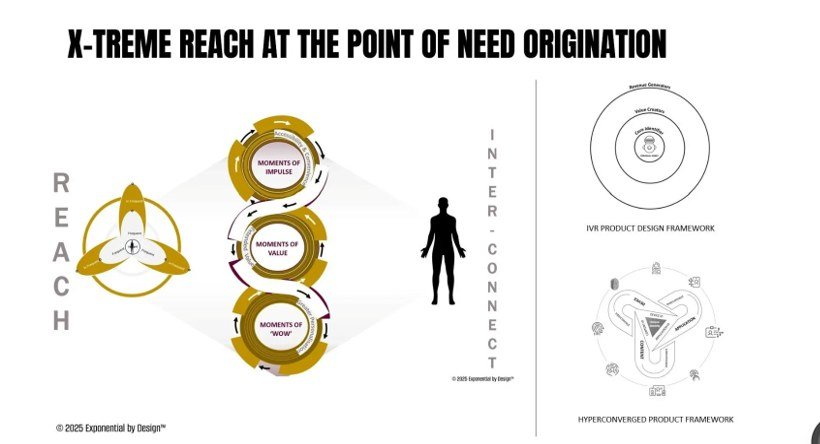
X-treme Reach at the point of need origination. Reach is designed around three moments in the customer’s life: moments of impulse, moments of value and moments of “wow”. The REACH Interconnect links the product to the customer at each of them.
The IVR Product Design Framework. An intelligent product is designed in three layers: a Core Identifier at the centre, Value Creators around it, and Revenue Generators at the outer layer.
The Hyperconverged Product Framework. The product joins the wider ecosystem of devices, services and data around the customer.
© 2025 Exponential by Design™Design Intelligent Experiences
Future-built enterprises design experiences that recognise the moment of truth and respond to it, so trust and influence build at near-zero marginal cost.
- Moments of truth
- The emotional network
Examples
Amul · Oreo
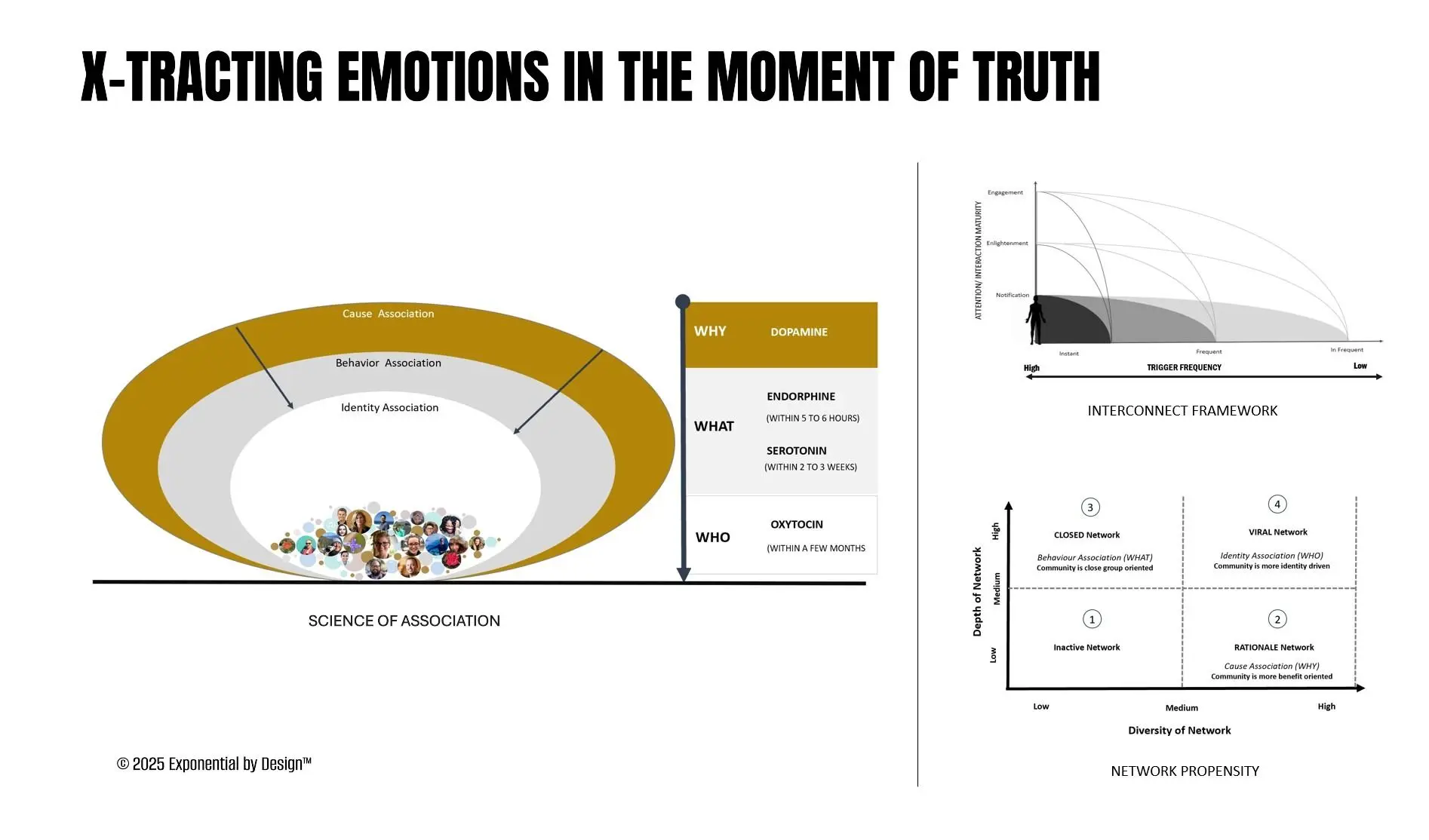
The emotional network. Trust, identity, belonging and influence, designed to act in the customer’s emotional moments at scale.
© 2025 Exponential by Design™Design Intelligent Value
Future-built enterprises keep extending the value they create, evolving the core at each tipping point instead of defending a single business.
- The evolving core
- Ecosystem leverage
Examples
Amazon · AirAsia
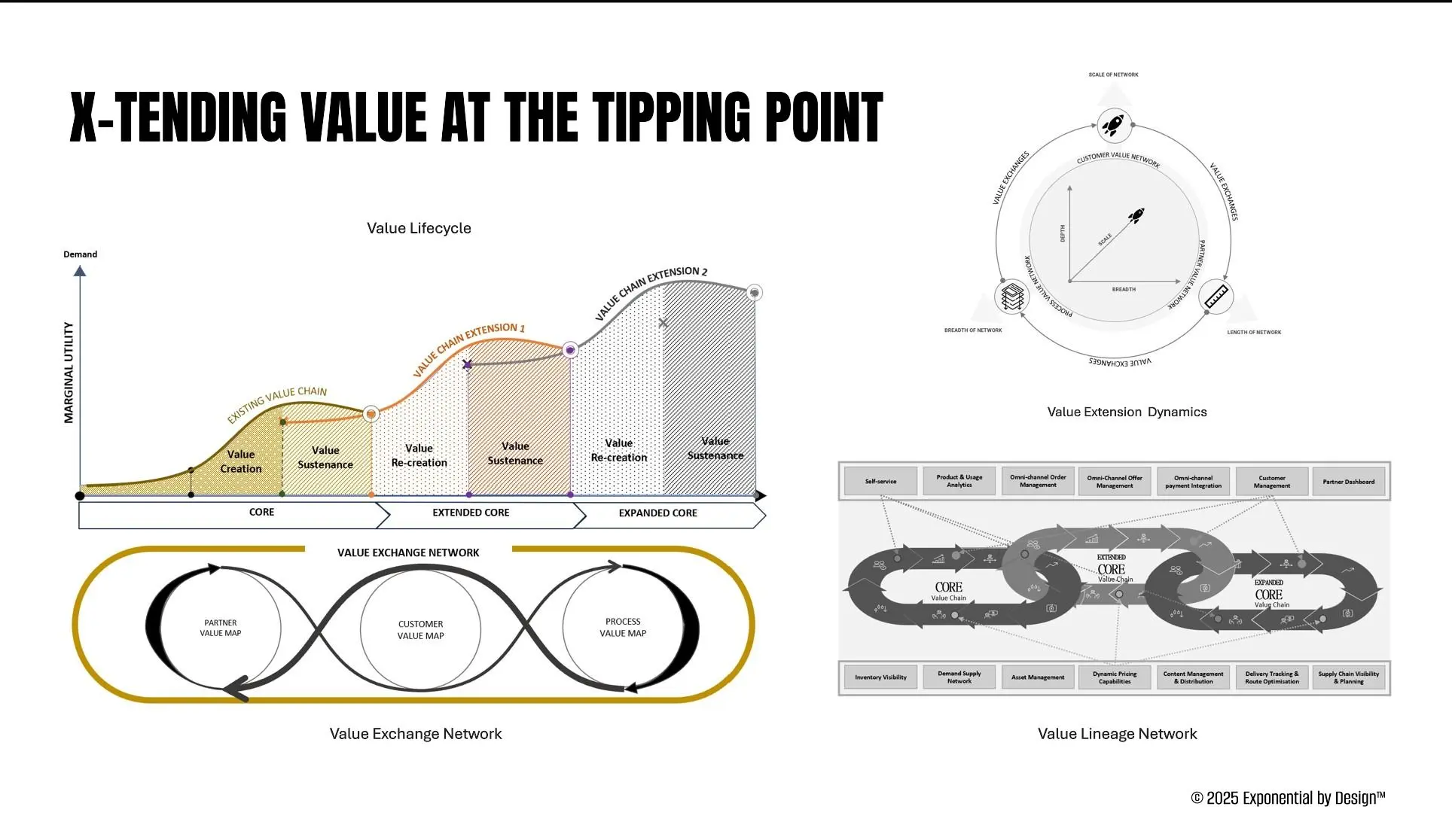
The value network. The creation, exchange and amplification of value across partners and ecosystems, extended at each tipping point.
© 2025 Exponential by Design™Design Scale
Future-built enterprises scale through connected networks, so reach and value grow faster than headcount and cost.
- Networks within networks
- Autonomous platforms
Examples
Samsung · Microsoft
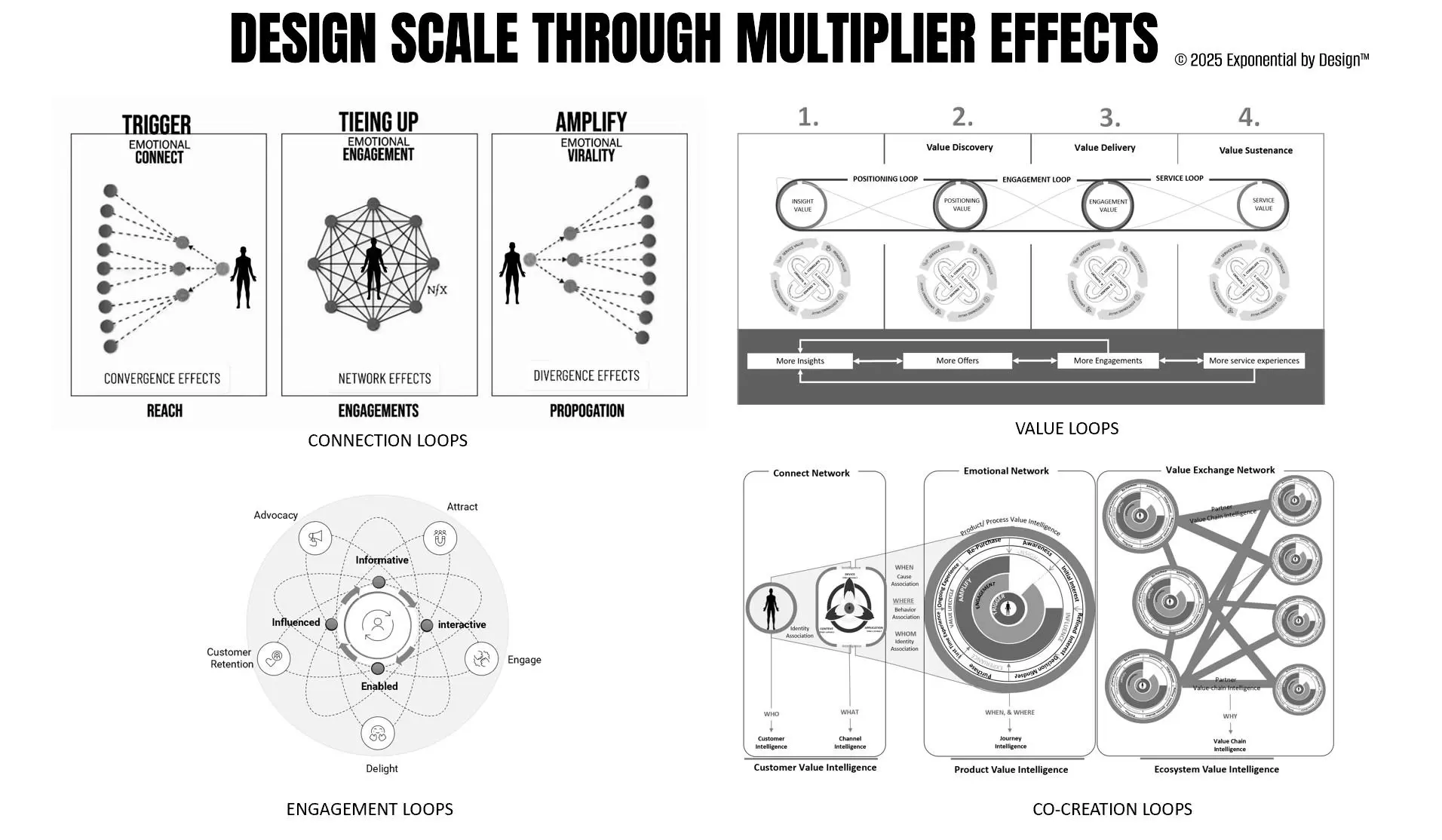
Networks within networks. Customers, products, partners, data and intelligence connected so that each network strengthens the others.
© 2025 Exponential by Design™Design Exponentiality
Future-built enterprises make intelligence the operating system of the business, so everything the organisation learns compounds across reach, influence and value.
- The intelligence network
- The cognitive enterprise
Examples
NVIDIA · John Deere
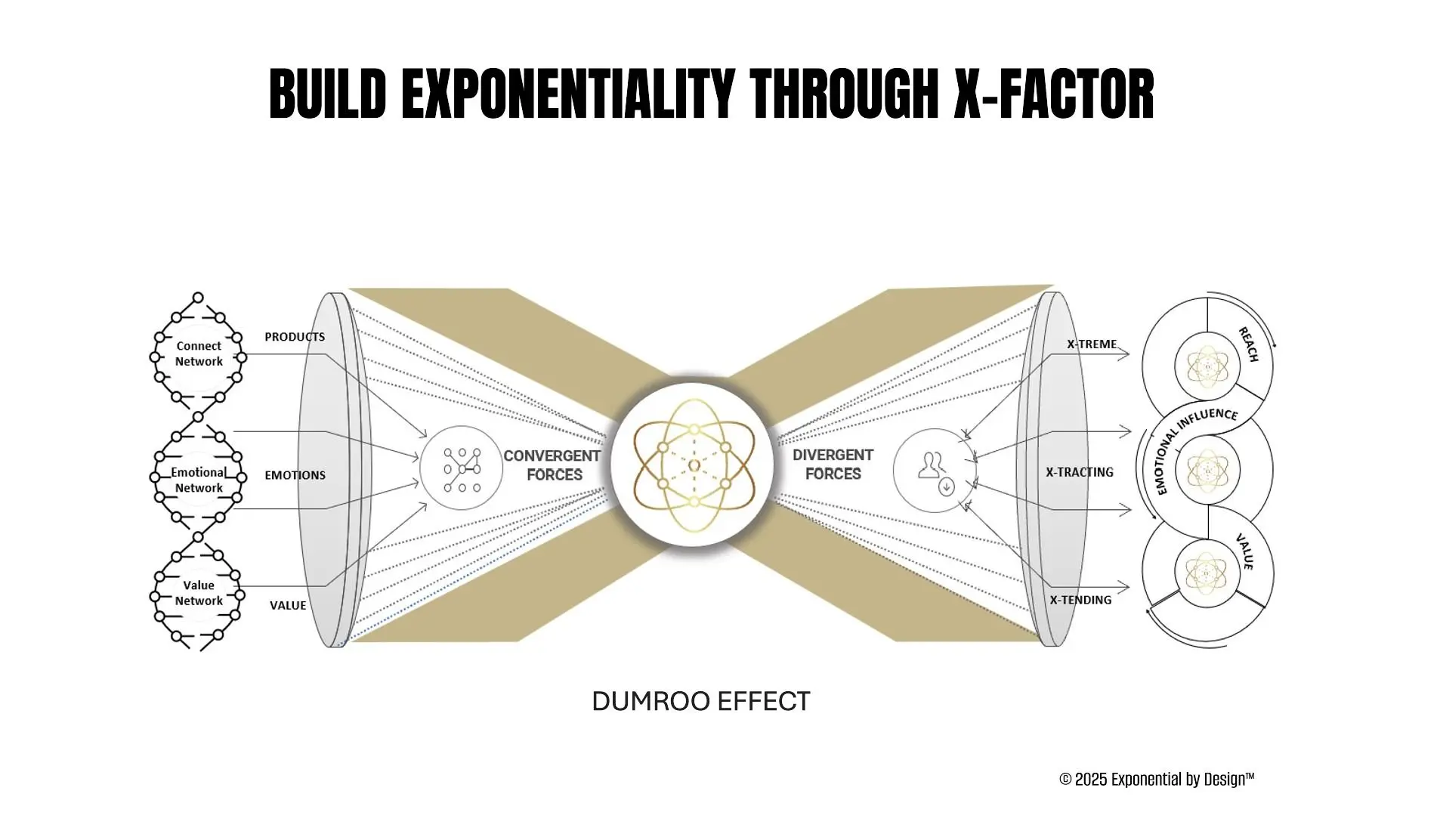
The intelligence network. Data, learning, prediction and inference running through every other network, which is how the three outcomes scale.
© 2025 Exponential by Design™Inside the book
Your map to exponential transformation.
Three parts, nine chapters. Every chapter sets out a framework that helps leaders turn complexity into compounding advantage, and almost every one has a short video from the author.
Introduction: Why Everything You Know About Growth Is About to Changep. 15
Part I · Visualising the Future & Navigating Disruption
Chapter 1 · The Rise of Exponentials
 Chapter 1 · The Rise of ExponentialsAnuj Pandey · Chapter video
Why linear thinking fails, and why exponential is the new normal.
Key highlights
- Why traditional linear thinking no longer works, and why exponential is the new normal.
- The impact of exponential technologies on industries and the wider business ecosystem.
Case studiesNVIDIA · OpenAI · Google
Part I · Visualising the Future & Navigating Disruption
Chapter 2 · Converged Horizon
 Chapter 2 · Converged HorizonAnuj Pandey · Chapter video
How technologies, data and networks are converging, and what that horizon means for strategy.
Part II · Building the Foundation
Chapter 3 · Hyper-converged Eco-system
 Chapter 3 · Hyper-converged Eco-systemAnuj Pandey · Chapter video
The construct of the hyper-converged ecosystem: designing adaptive, intelligent systems.
Part II · Building the Foundation
Chapter 4 · The ‘X’ Factor Unveiled
Convergence, divergence and the X-Factor: growth that a linear business model cannot replicate.
Part II · Building the Foundation
Chapter 5 · ‘X’-treme Reach
 Chapter 5 · X-treme ReachAnuj Pandey · Chapter video
Designing products that reach the customer at the point where a need first appears.
Part II · Building the Foundation
Chapter 6 · ‘X’-tract Emotional Influence
 Chapter 6 · X-tract Emotional InfluenceAnuj Pandey · Chapter video
The emotional network: designing experiences that influence at the moment of truth.
Part II · Building the Foundation
Chapter 7 · ‘X’-tend Value
 Chapter 7 · X-tend ValueAnuj Pandey · Chapter video
The value network: extending value through ecosystem leverage at each tipping point.
Part III · Scaling
Chapter 8 · ‘X’-pand Intelligence
 Chapter 8 · X-pand IntelligenceAnuj Pandey · Chapter video
The intelligence network and the era of cognitive enterprises: how the outcomes scale.
Part III · Scaling
Chapter 9 · Concluding Thoughts
 Chapter 9 · Concluding ThoughtsAnuj Pandey · Chapter video
The future belongs to those who are exponential by design.
REWIRE X Phase 1 · Modules 1–2
REWIRE X Phase 2 · Modules 2–5
REWIRE X Phase 3 · Module 6
Why it matters
The gap between AI leaders and everyone else is already measurable.
1.7×
Revenue growth of AI leaders compared with laggards.
1.6×
EBIT margin of the same leaders.
3.6×
Three-year total shareholder return.
Source: BCG, The Widening AI Value Gap: Build for the Future 2025, 30 September 2025. Survey of 1,250 senior executives; "AI leaders" are the 5% of companies BCG classes as future-built.
Read the opening chapter before you buy.
Reading it together?
Leadership teams use the book as shared pre-reading before a strategy offsite, and business schools adopt it for courses on strategy and AI. Ask about team copies and an author session.
Talk to us →Questions
About the book.
Who is the book for?
Leaders who own growth or transformation, the teams who carry it out, and management students who will lead organisations shaped by AI.
Is it a book about AI?
It is a book about growth. AI is the force that makes the argument urgent, but the subject is how organisations are designed to compound: their products, experiences, value and networks.
Do I need a technical background?
No. The book is written for business leaders. Where technology matters, it is explained through what it changes in the business.
How does the book relate to REWIRE X?
The book creates the mental model. REWIRE X turns it into capability through six modules of cases, exercises and application. Many readers start Module 1 after finishing the book.